
Have you ever really stopped to think, financially speaking, about how profitable the ads you run on platforms like Google, Meta, LinkedIn, and others actually are? And the answer is: “YES, DIEGO! Of course we’ve thought about it. With the ads team, we look for ways to lower CPC to get a more attractive CPA, and we work closely with the sales team to achieve an LTV that offsets that ad investment.”
And yes, that’s exactly what every company is ultimately trying to do… buuuuut if we look a little deeper, all this really means is that we’re paying for clicks/visits, messages/conversations, and, when ads actually work (which they don’t always) for sales. So my question is this:
At what point does it make sense to say, “Okay, let’s invest in SEO”?
To answer that, I usually like to dig into the business and understand the current metrics. But to simplify things, what really matters is knowing when acquisition costs start eating into your margins or when you realize that the moment you stop paying… you stop existing.
As business owners, we’re always chasing the highest possible return from every marketing strategy in the shortest amount of time, and that’s the problem. We’ve become so used to immediacy that we get frustrated when we don’t see RESULTS right away. And many times, we end up dropping an SEO strategy because it doesn’t deliver instant results, even though we’ve been told a thousand times: “SEO is a medium- to long-term game.”
The same thing happens with SEO content creation: article after article, trying to move the metrics somehow. Of course, all of this is a process, and it works like the snowball effect the more effective work you do over time (and no, this is not about doing work just to check a box), the better the results will be in the end.
The point I’m trying to make is that immediacy isn’t always the best campaign, and the “best” campaign doesn’t always bring the best results. We have to learn how to be relevant and stand out in a market that’s extremely competitive and evolving more and more every day.
Lastly, I want to close with this chart that helps explain the correlation between renting an audience (SEM) and owning your own channel (SEO).
SEO performance vs. SEM
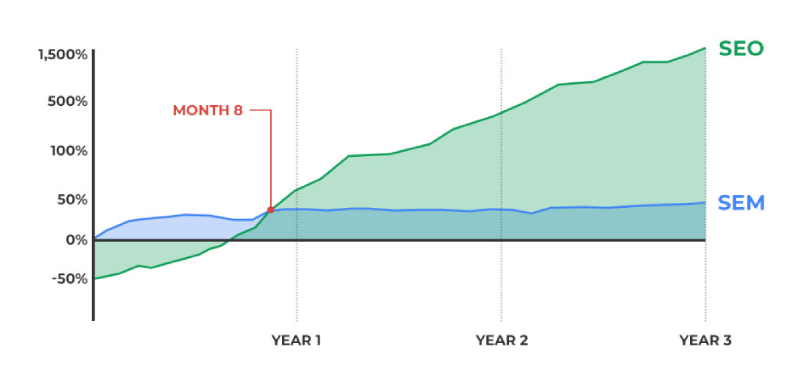
Analysis published by First Page Sage.
I find this analysis fascinating, and honestly, pretty eye-opening. While SEM costs are linear and relatively stable, SEO follows a curve that, once it takes off, drastically reduces acquisition costs in the long run. This makes me think about the huge range of opportunities out there and how these tools and strategies can be used to scale results in both Google Ads and SEO… but that’s a conversation for another post.
Question: Are you renting audiences, or are you building an asset of your own? I’ll read you in the comments.